

.webp?width=1200&height=698&name=menu%20item%20-%20fashion%20(1).webp)








.webp?width=1200&height=544&name=menu%20item%20-%20collaboration%20(2).webp)
.webp?width=1200&height=544&name=menu%20item%20-%20samples%20(1).webp)
.webp?width=1200&height=544&name=menu%20item%20-%20profit%20%26%20margins%20(1).webp)
.webp?width=1200&height=544&name=menu%20item%20-%20compliance%20(1).webp)




ESG & Compliance
Certifications are everywhere in fashion. The slightly trickier part is understanding exactly what has been certified. Because a certified supplier, a certified fabric and a certified T-shirt are not necessarily the same thing.
What does certified actually mean?
GOTS, OEKO-TEX, GRS, RWS, FSC. Fashion has collected quite the alphabet of certifications over the years. At its simplest, a certification is proof that something has been checked against a defined set of requirements. Depending on the certification, that "something" could be a material, a finished product, a production process or even parts of the supply chain behind it.
There is a good reason certifications have become such a familiar part of fashion. Most brands do not grow the cotton, spin the yarn, dye the fabric and sew the final garment themselves. A product passes through many hands, often across several countries, and brands need ways of documenting what happened before it reached them.
Certification systems help create that common language. Standards such as GOTS and OEKO-TEX are developed and managed by independent organisations, with approved certification bodies or institutes carrying out the actual audits, assessments and testing. So when a supplier says something is certified, there should be more behind that statement than a logo in a presentation. There are requirements to meet and documentation to back it up.
GOTS, OEKO-TEX or both?
Take a simple cotton T-shirt. You want organic cotton, so GOTS comes up. Then someone asks about harmful substances and OEKO-TEX enters the conversation. Do you need to choose? Do you need both? And aren't they basically telling you the same thing? Not quite.
GOTS looks at textiles made with certified organic fibres and follows them through processing and manufacturing. It does not stop at whether the cotton started out organic. The standard also includes requirements around chemicals, environmental management, working conditions and traceability through the certified supply chain.
OEKO-TEX STANDARD 100 answers a different question. Here, the focus is whether a textile article has been tested for harmful substances. And it is not only the main fabric that matters. Thread, buttons, zips, prints and other components can all form part of the testing.
So the two can sit on the same T-shirt without doing the same job. That is why "Which certification is best?" is probably the wrong place to start. What are you trying to document? Organic fibre content and processing? Testing for harmful substances? Both? Something entirely different? Start there, and the alphabet becomes a little easier to understand.
Your supplier is certified. Is your product?
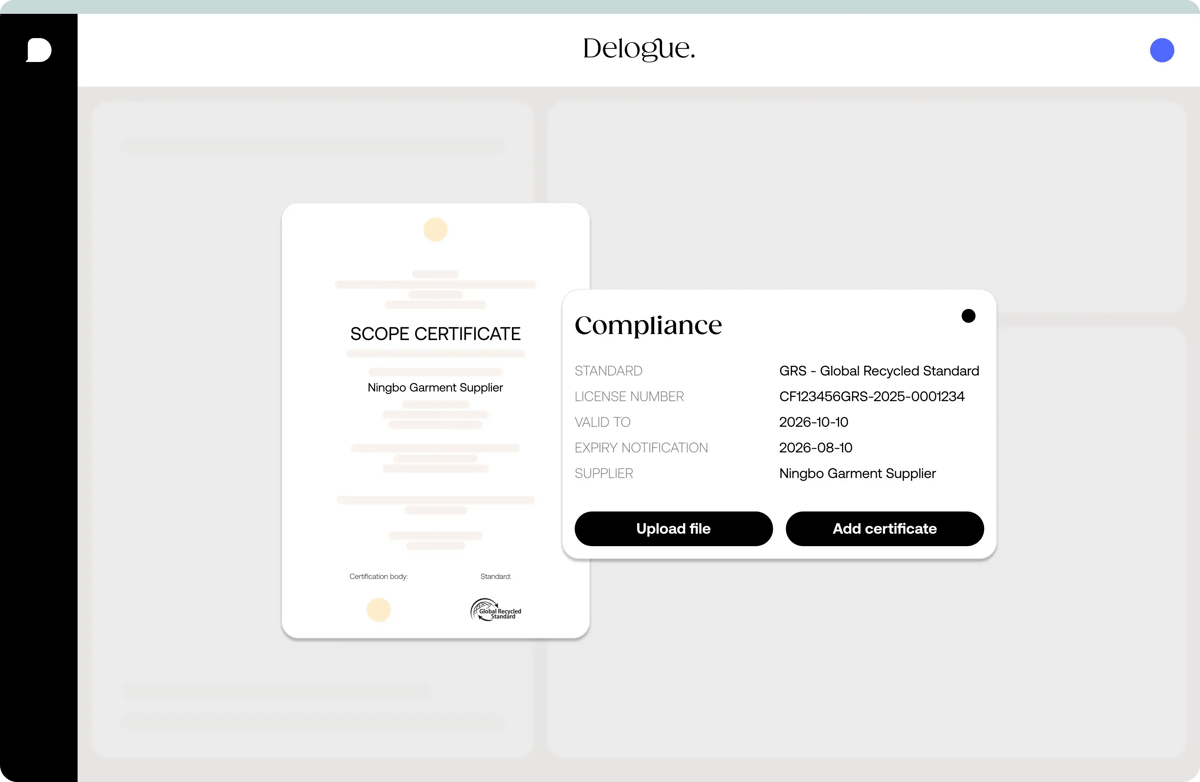
Your supplier sends over their GOTS Scope Certificate. Great. But does that prove the 500 T-shirts you just bought were made with certified organic cotton? Not quite. A Scope Certificate tells you that the supplier is certified and what their certification covers. A Transaction Certificate, or TC, takes it one step further. It follows a specific transaction and documents the certified products, materials and quantities that were actually sold to you.
That distinction is particularly useful if your own company is not GOTS certified. You may still source certified organic material and use the documentation from your supplier to substantiate information about the fibre content of your product. But having a TC does not automatically give you permission to call the finished product GOTS certified or put the GOTS logo on it. GOTS has separate rules for when its name and logo can be used.
And that is really the important distinction. Whether proving what is in your product and claiming that your product itself is certified are not the same thing. For brands, the question is therefore not always "Should we become certified?" It can also be "What do we want to communicate, and what documentation do we need to prove it?"
The certificate is only the beginning
There is a folder somewhere in almost every fashion company called something along the lines of "Supplier certificates". Inside are PDFs. Lots of PDFs. The harder question is whether anyone knows which materials they cover, which products use them and when they expire.
That is why certification is also about supplier collaboration. Brands need documentation from further down the supply chain, and that documentation needs to stay connected to the material or product it belongs to. A PLM can help keep those connections in place instead of leaving certificates scattered across inboxes and folders.
It matters for the claims you make today, but also for what comes next. The ESPR regulation and the coming Digital Product Passport are moving the industry towards more structured product information and stronger documentation. So before collecting another certification, start with what your business actually needs. What do you want to say about your products? What can your suppliers already prove? And where does becoming certified yourself justify the extra work and cost? A certification should support your strategy, not become the strategy.
Check out our monthly webinar
Every month, we host a webinar, often in collaboration with our IT solution partners and leading industry brands. The topics vary, but one thing remains the same: we aim to make the fashion industry’s challenges more manageable and share our take on practical, hands-on solutions.
Check out this month’s webinar by clicking the button below.
6 minute read