
.webp)
.webp)
.webp?width=600&height=349&name=menu%20item%20-%20fashion%20(1).webp)



.webp?width=2000&name=menu%20item%20-%20collaboration%20(2).webp)
.webp?width=2000&name=menu%20item%20-%20samples%20(1).webp)
.webp?width=2000&name=menu%20item%20-%20profit%20%26%20margins%20(1).webp)
.webp?width=2000&name=menu%20item%20-%20compliance%20(1).webp)





PLM & Product Development

The fashion industry still accounts for around 1.2 billion tonnes of CO₂ emissions every year - more than the shipping and aviation industries combined. As sustainability expectations continue to rise, brands are under increasing pressure to improve the way they manage production, sourcing, and material use.
A 2018 Quantis study found that over 90% of fashion’s emissions come from just four activities: dyeing and finishing, fabric preparation, yarn preparation, and fibre production. All of these stages depend on accurate order estimates - producing only what’s actually needed. And at the heart of those estimates lies the Bill of Materials (BoM).
When managed through a PLM BoM system, brands can ensure full visibility of every material, trim, and process across their supply chain. While inaccurate BoMs can cause overproduction and waste, well-structured and precisely forecasted BoMs - supported by PLM BoM management - can become your brand’s hidden sustainability hero.
What is a Bill of Materials (BoM)?
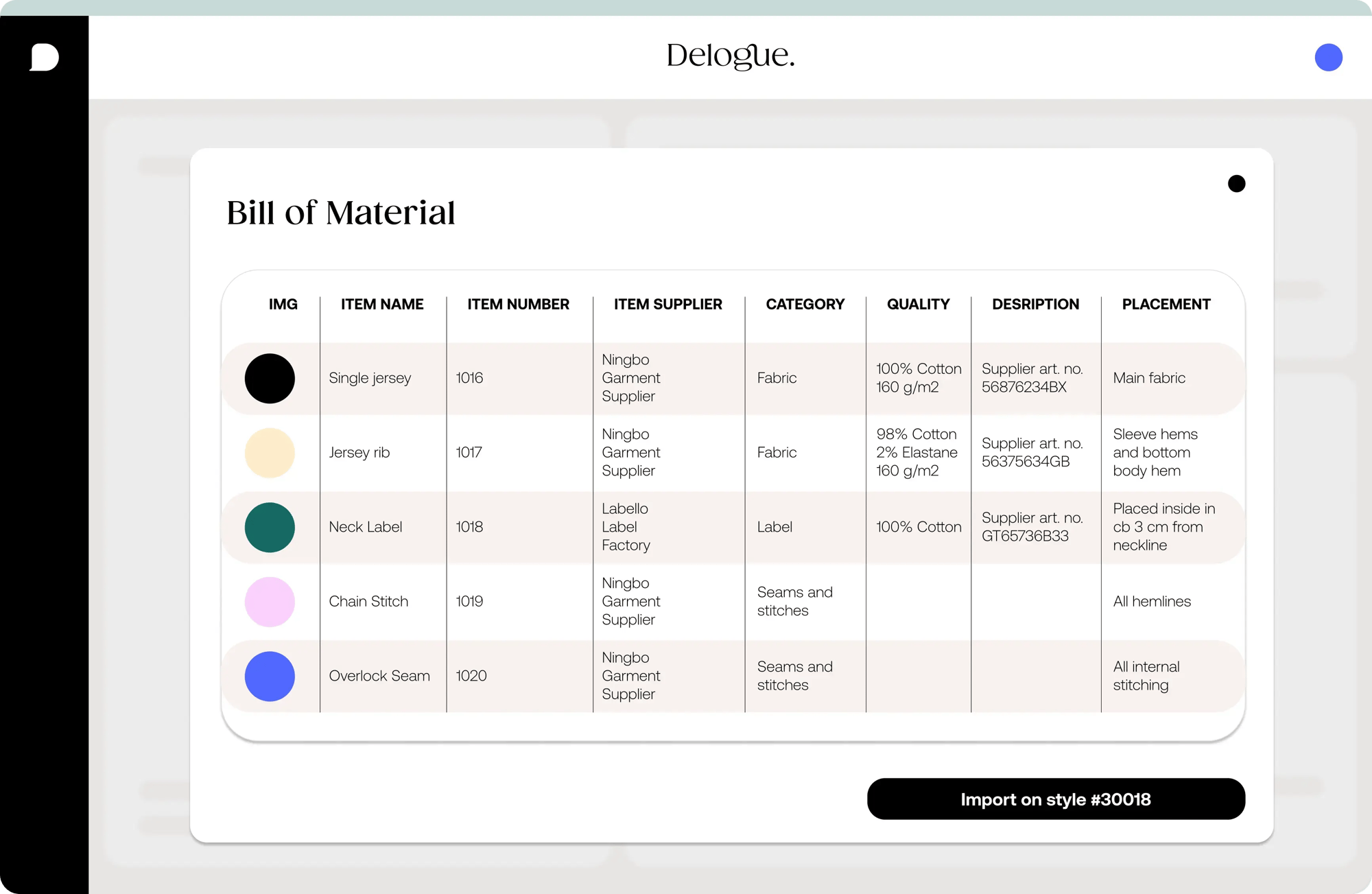
A Bill of Materials (BoM) is a detailed list of every item, material, and component used to create a product - often referred to as the product’s “shopping list.”
When managed within a PLM BoM setup, this data becomes part of a connected workflow that ensures accuracy from design to production. A complete BoM in PLM covers every detail - fabrics, trims, threads, zippers, and buttons - including information about size, colour, supplier, and placement.
This structured overview, enabled by PLM BoM management, allows brands to control material costs, plan purchasing efficiently, and minimise waste - while ensuring no component is overlooked.
Why the BoM Matters Across the Value Chain
The BoM begins in design, where the first ideas, sketches, and specifications take shape. Product development teams then transform those creative inputs into detailed material requirements and accurate costings. Product technicians verify patterns, measurements, colours, and quality before handing everything over to suppliers.
Even the smallest error can create ripple effects throughout the production cycle. Miscalculated quantities can disrupt inventory or delay production. Inaccurate product costing can distort profitability forecasts. And incomplete data can result in quality issues or even customer returns.
In short: a precise, well-managed BoM is the backbone of a smooth and sustainable value chain.
How the BoM Supports Brand Sustainability
As fashion brands strengthen their sustainability strategies - driven by regulation, values, and profitability - the BoM becomes a key tool for responsible production.
A thorough BoM enables better decisions at every stage:
1. Choosing regenerative or recycled materials over harmful ones
2. Opting for cleaner, more efficient processing methods
3. Engaging suppliers early to align on sustainable practices and data transparency
By managing these elements within one unified PLM BoM system, brands can reduce waste, optimise material use, and document the environmental footprint of each product more accurately.
Through BoM management in PLM, teams gain a single source of truth for materials and components - enabling measurable sustainability that starts in design, not just production.
How BoM Management in PLM Improves Accuracy
Within a PLM system, much of the documentation process, including Bill of Materials generation, can be automated.
With PLM, BoMs are dynamically linked to design and development data, allowing seamless updates from season to season. This reduces human error and ensures that changes are instantly reflected across teams.
Because PLM operates as a collaborative environment, design, sourcing, and production teams all work with the same data - making it easier to align creative intent with technical feasibility. That means design adjustments and supplier updates happen early and efficiently, preventing downstream issues and wasted resources.
Ultimately, a well-implemented PLM system turns BoM management into a strategic advantage: more precision, more transparency, and less waste.
PLM vs ALM: Understanding the Difference
While PLM is tailored for managing physical product lifecycles, from concept to production, ALM (Application Lifecycle Management) serves a similar purpose in the software world.
Both systems aim to improve collaboration, transparency, and efficiency throughout a product’s lifecycle, but they do so in different contexts:
PLM focuses on fashion, design, manufacturing, and supply chain processes.
ALM focuses on software development, version control, testing, and release management.
In other words, the difference between ALM and PLM lies in what they manage: physical products versus digital applications.
Still, there’s an increasing overlap in principles - especially as fashion tech evolves. Understanding both PLM and ALM helps brands and developers collaborate better, applying lifecycle thinking not just to clothing, but to the digital tools that power the industry.
The Bottom Line
A sophisticated Bill of Materials lays the foundation for a resource-efficient, sustainable value chain. But true sustainability only happens when every stakeholder and every system, from design to supplier collaboration, aligns on shared goals.
Book a demo and see how Delogue PLM can help you build accurate BoMs, streamline your product data, and take meaningful steps toward sustainable production.
Check out our monthly webinar
Every month, we host a webinar, often in collaboration with our IT solution partners and leading industry brands. The topics vary, but one thing remains the same: we aim to make the fashion industry’s challenges more manageable and share our take on practical, hands-on solutions.
Check out this month’s webinar by clicking the button below.
9 minute read