
.webp?width=1200&height=698&name=menu%20item%20-%20fashion%20(1).webp)


.webp?width=1200&height=544&name=menu%20item%20-%20collaboration%20(2).webp)
.webp?width=1200&height=544&name=menu%20item%20-%20samples%20(1).webp)
.webp?width=1200&height=544&name=menu%20item%20-%20profit%20%26%20margins%20(1).webp)
.webp?width=1200&height=544&name=menu%20item%20-%20compliance%20(1).webp)


FashionTech Solutions
PLM, ERP, MES, PDM, CRM, PIM… fashion tech acronyms can feel endless. But behind the alphabet soup, two systems define how brands build efficient, data-driven operations: PLM (Product Lifecycle Management ) and ERP (Enterprise Resource Planning).
Both play critical roles in connecting teams and controlling complexity. The question is in the ongoing debate of PLM vs. ERP, where should your fashion brand start?
What are ERP and PLM systems?
To understand the difference between ERP and PLM, we first need to break the two systems down.
ERP
An ERP system manages your company’s core business processes - finance, logistics, manufacturing, and sales. It’s the operational backbone that connects accounting, order management, and inventory planning.
For fashion brands, ERP and PLM systems together can enable complete visibility, but ERP alone focuses mainly on numbers. It tracks what you sell, what you produce, and how much it costs.
Larger fashion houses with in-house production rely heavily on advanced ERP setups to monitor sales, costs, margins, and stock. Smaller or outsourced operations may use lighter ERP solutions centred around basic financial management and reporting.
PLM
A PLM system connects the creative and technical sides of product development. It centralises data, workflows, and communication from the first sketch to final shipment, covering everything from design and sourcing to production and compliance.
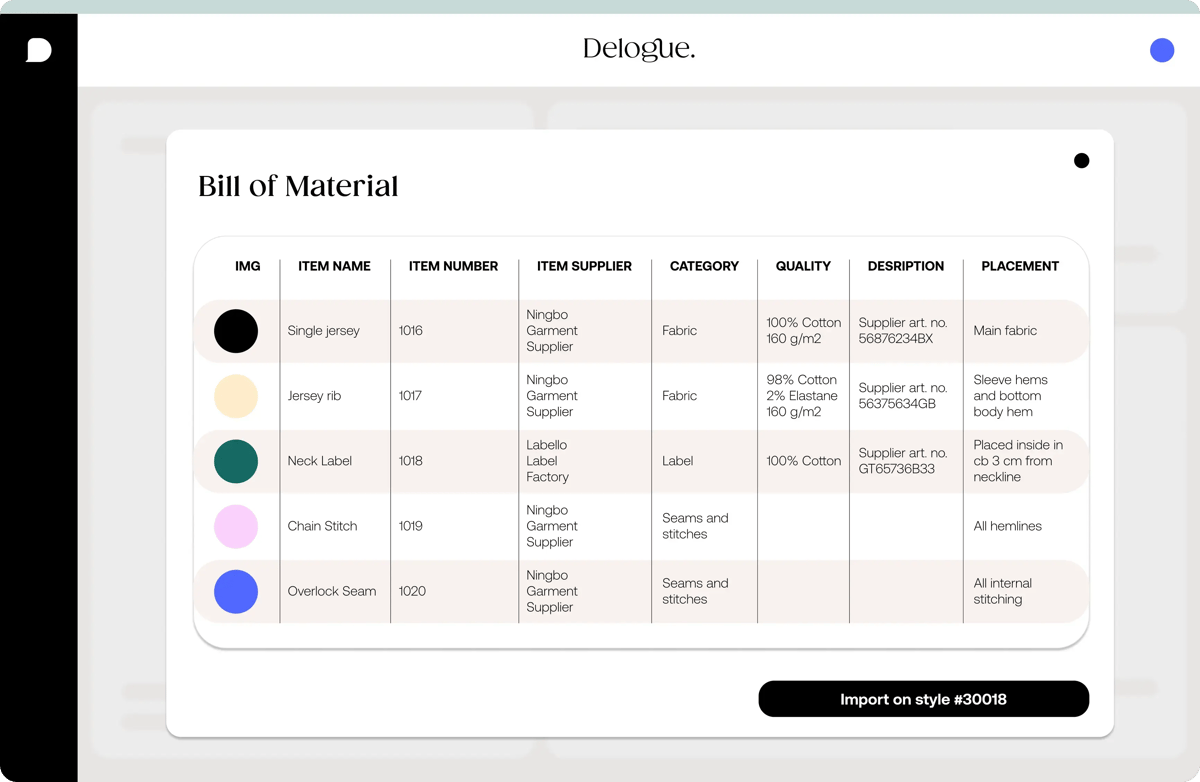
Cloud-based PLM solutions (like Delogue PLM) keep all product information (BOMs, tech packs, supplier quotes, material data) in one place and updated in real time. This makes PLM and ERP collaboration seamless, while ensuring every stakeholder works with accurate product data.
For any brand that designs, develops, or manufactures products, PLM is the foundation for efficiency and collaboration.
The difference between ERP and PLM
Let’s take a closer look at the real difference between ERP and PLM.
While PLM and ERP systems complement each other, they solve different problems. ERP captures hard data (sales, costs, logistics, and HR). PLM handles soft data (designs, materials, changes, and documentation).
Think of PLM as your single source of product truth. It feeds accurate product data into the ERP system, ensuring financial decisions are based on reliable, up-to-date information.
This is why more fashion executives are moving away from an “ERP-first” mindset. By implementing PLM first, brands create a strong data foundation, making ERP integration smoother, faster, and more valuable.
When to Start: Two Common Scenarios
Scenario 1: Building Your First Tech Stack
When you’re just starting out, it’s tempting to wait before investing in systems. But as collections grow and teams expand, fragmented tools and endless spreadsheets quickly become unmanageable.
Starting with PLM gives you control over product data and workflows early on. Then, when it’s time to implement ERP, your processes are already structured and your product data clean - the ideal foundation for resource planning and profitability tracking.
In short: build a flawless product before you start optimising your finances.
Scenario 2: Moving from on-premise to cloud-based systems
Many established brands still run legacy, on-premise ERP systems that can’t keep up with modern business needs. Transitioning to a cloud-based ERP is far easier when a PLM system is already in place.
PLM acts as your “data safe haven,” storing clean, structured product data. This eliminates tedious migration work - no more messy exports from PIMs, Excel sheets, or old ERP databases.
The result? Faster, cleaner integrations and a more connected digital ecosystem.
PLM vs ERP vs MES: How manufacturing execution fits in
As more brands optimise their production workflows, another system enters the picture: MES (Manufacturing Execution Systems)
MES connects your production floor with your planning tools - tracking what’s happening in real time: output, downtime, material use, and quality control.
Here’s how the three systems work together:
PLM manages the creation of the product - design, materials, specifications.
MES oversees the production - what’s happening in the factory, minute by minute.
ERP handles the business side - inventory, finance, and resource planning.
Together, PLM, ERP, and MES form a connected digital thread from concept to delivery. For fashion brands, this trio can unlock total visibility - from sketch to store.
so, PLM and ERP: Either-or or better together?
The difference between PLM and ERP isn’t about choosing one over the other. It’s about understanding how they complement each other.
PLM brings structure to product data and collaboration. ERP brings financial control and operational oversight. Together (and increasingly, alongsiden MES) they create the full picture: creative precision backed by business efficiency.
To future-proof your fashion business, prioritise a cloud-based PLM systems as your starting point, then connect it with ERP (and eventually MES) for a truly integrated digital backbone.
Check out our monthly webinar
Every month, we host a webinar, often in collaboration with our IT solution partners and leading industry brands. The topics vary, but one thing remains the same: we aim to make the fashion industry’s challenges more manageable and share our take on practical, hands-on solutions.
Check out this month’s webinar by clicking the button below.
9 minute read