
.webp?width=1200&height=698&name=menu%20item%20-%20fashion%20(1).webp)






.webp?width=1200&height=544&name=menu%20item%20-%20collaboration%20(2).webp)
.webp?width=1200&height=544&name=menu%20item%20-%20samples%20(1).webp)
.webp?width=1200&height=544&name=menu%20item%20-%20profit%20%26%20margins%20(1).webp)
.webp?width=1200&height=544&name=menu%20item%20-%20compliance%20(1).webp)





FashionTech Solutions

In fashion, data isn’t just numbers, it’s knowledge. The more connected your systems are, the more value that data creates. Integrating Delogue Product Lifecycle Management (PLM) with your ERP system allows you to turn disconnected information into a single, efficient workflow.
At Delogue, we support a best-of-breed tech-stack approach - because every business has unique needs. While we do know how to do PLM, we also know that extending Delogue’s functionality through connecting PLM and ERP systems helps your business scale smarter. In short: we support your growth, no matter what technology you choose.
ERP and PLM integration
Integration connects one system to another, allowing data to flow seamlessly between them. When you choose PLM integration with ERP through Delogue, product data generated in Delogue automatically transfers to your ERP - improving data quality, minimising manual entry, and saving valuable time.
Whether you’re syncing product, supplier, or material data, a PLM-to-ERP integration ensures that every update in one system is instantly reflected in the other, creating a unified, accurate foundation for decision-making and reporting.
Common integrations with Delogue PLM
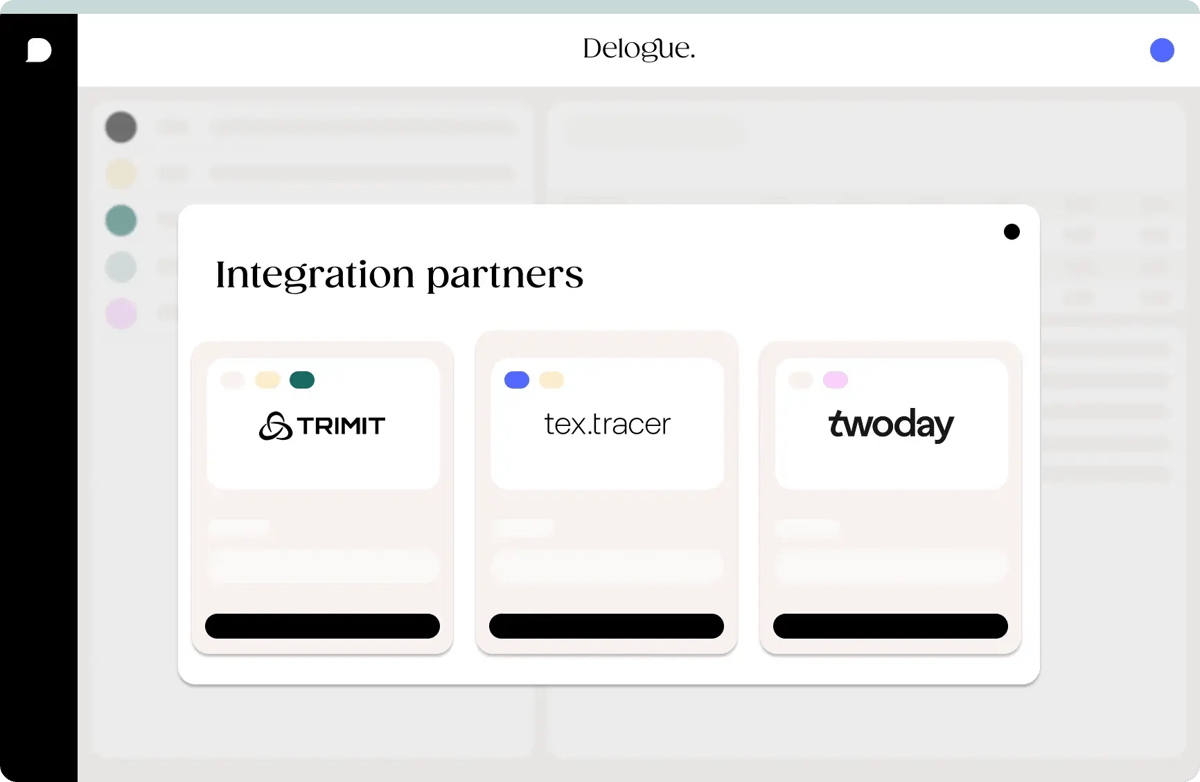
Delogue connects easily with the tools you already rely on. Through our partner ecosystem, you can integrate Delogue with ERP, PIM and B2B/B2C e-commerce platforms.
We’re also expanding toward integrations with calculation, auditing and compliance systems to better support CSR, sustainability, and quality control processes. You can view all active and upcoming partner integrations on our dedicated Integrations page here.
Delogue PLM integration with ERP - step by step
Every business runs a different IT setup, so our integrations are designed to be flexible. Most brands use Delogue's web services to connect with their ERP through a REST API, but other methods, like webhooks, timestamp web services, or file transfer protocols (FTP), may be better suited depending on your infrastructure.
1. PLM to ERP integration via REST API
PLM to ERP integration via REST API is the common approach. Your ERP provider receives an API key to access Delogue data. They send a request with a specific style number to fetch the relevant product data as a JSON file. This setup enables fast, real-time product lifecycle management in ERP.
2. Using a webhook for PLM-to-ERP communication
A webhook allows a user in Delogue (e.g. designer, technician, or buyer) to manually trigger the data exchange. When a style is ready, the webhook prompts the ERP to fetch that style’s data from PLM - no waiting for scheduled updates.
3. Integrating with a timestamp web service
The ERP sends a timestamp (e.g. “yesterday at 23:00”) to Delogue. Using that timestamp, Delogue identifies which styles were updated and returns a list for synchronisation. This keeps ERP and PLM systems perfectly aligned without redundant requests.
4. File Transfer Protocol (FTP)
For older or on-premise ERP systems, Delogue can exchange data via XML files through an FTP server. Delogue pushes updated data to the FTP folder, the ERP checks for new files, imports the data, and removes the file once processed. This traditional method remains effective for legacy systems.
Each integration method is chosen based on your ERP setup. For SaaS-based ERP platforms, web-service or API integration is typically the fastest and most scalable solution.
You own your data
No matter how your PLM and ERP systems are integrated, your data always belongs to you - not to Delogue. You can easily export your product information in Excel or XML formats through the standard Export functionality in your Delogue Admin section.
Building a PLM implementation strategy
A strong PLM implementation and PLM strategy is the foundation of successful digital transformation. Integrating systems is only one part - aligning people and processes is just as critical.
Before you start your PLM implementation, consider:
1. How your product data is structured across teams.
2. Which processes will benefit most from automation.
3. How integration with ERP and other systems supports your overall business goals.
A thoughtful approach to PLM deployment ensures smoother adoption, faster ROI, and a stronger base for ongoing digital transformation.
At Delogue, we guide brands through every step - from PLM development and change management to seamless ERP integration. Because technology should empower your people, not overwhelm them.
Check out our monthly webinar
Every month, we host a webinar, often in collaboration with our IT solution partners and leading industry brands. The topics vary, but one thing remains the same: we aim to make the fashion industry’s challenges more manageable and share our take on practical, hands-on solutions.
Check out this month’s webinar by clicking the button below.
8 minute read