
.webp?width=1200&height=698&name=menu%20item%20-%20fashion%20(1).webp)




.webp?width=1200&height=544&name=menu%20item%20-%20collaboration%20(2).webp)
.webp?width=1200&height=544&name=menu%20item%20-%20samples%20(1).webp)
.webp?width=1200&height=544&name=menu%20item%20-%20profit%20%26%20margins%20(1).webp)
.webp?width=1200&height=544&name=menu%20item%20-%20compliance%20(1).webp)




ESG & Compliance

Supply chain mapping is quickly becoming part of everyday work in fashion. Not just because of regulations, but because better visibility leads to better decisions from the very start. In this article, we explore what it really means to map your supply chain, how to approach it step by step, and how it can naturally become part of your product development process with Delogue PLM.
Understanding the supply chain
So what do we actually mean when we talk about supply chain mapping? Put simply, it is about knowing where your product comes from. Not just the finished garment, but everything that goes into it along the way.
If we take a jacket as an example, it is about understanding where each part comes from. The fabric, the buttons, the zipper, the thread. And when you start looking a bit closer, it quickly becomes more detailed. Where was the fabric woven? Where was it dyed? What treatments were applied? Which supplier handled which step? A single garment moves through far more hands and processes than most people ever realise.
This is exactly why supply chain mapping has become such a big topic in the fashion industry right now. Not because it suddenly became interesting, but because it has become necessary. Regulations are pushing brands to move from assumptions to actual knowledge. With CSRD, retailers are already asking for more detailed information, like country of origin for raw materials. And with ESPR and the Digital Product Passport on the way, visibility across tiers will become even more important.
“
“Knowing your supply chain is no longer just about transparency. It is about being able to operate with confidence.”
Anja Padget, Chief Marketing Officer and ESG Expert at Delogue PLM
The supplier side of the story
As we touched on earlier, a garment passes through many different hands before it reaches the final product. And in fashion, it is very rare for a brand to own that entire journey. You might come across a company that controls everything from farm to finished garment, but that is the exception rather than the rule.
In most cases, the real knowledge of the supply chain sits with suppliers and sub-suppliers. They are the ones handling the spinning, weaving, dyeing, assembling, and finishing. Product developers, sourcing teams, and suppliers each hold their own part of the picture, but no one sees it all at once. That is where things can become challenging. Information is often shared across emails, spreadsheets, and ongoing conversations. Suppliers are also managing requests from multiple brands, each asking in different ways about similar insights about materials, processes, and origins. Over time, this creates a fragmented flow of information that is difficult to piece together into a clear overview.
Starting where the product is born
So how do we actually begin? How do we make supply chain mapping something that works in practice, both for brands and for suppliers, without it feeling overwhelming from the start?
The key is to begin where the product already exists in your process. Most brands already hold valuable information at style and BOM level. That is where the first layer of mapping can naturally take place. From there, it becomes about building step by step. Asking the right questions, structuring the data you already have, and creating routines together with your suppliers. Because the reality is that a fully mapped supply chain does not appear overnight. Suppliers are not sitting on perfectly structured data ready to be shared at any moment. It takes time, collaboration, and trust to build that level of visibility.
What starts to happen along the way is often even more valuable. You gain a clearer understanding of your supplier relationships, where your materials come from, and where reliable and validated data is actually available. It opens up better conversations, more informed sourcing decisions, and a stronger foundation for everything from compliance to product development.
Where mapping meets everyday work
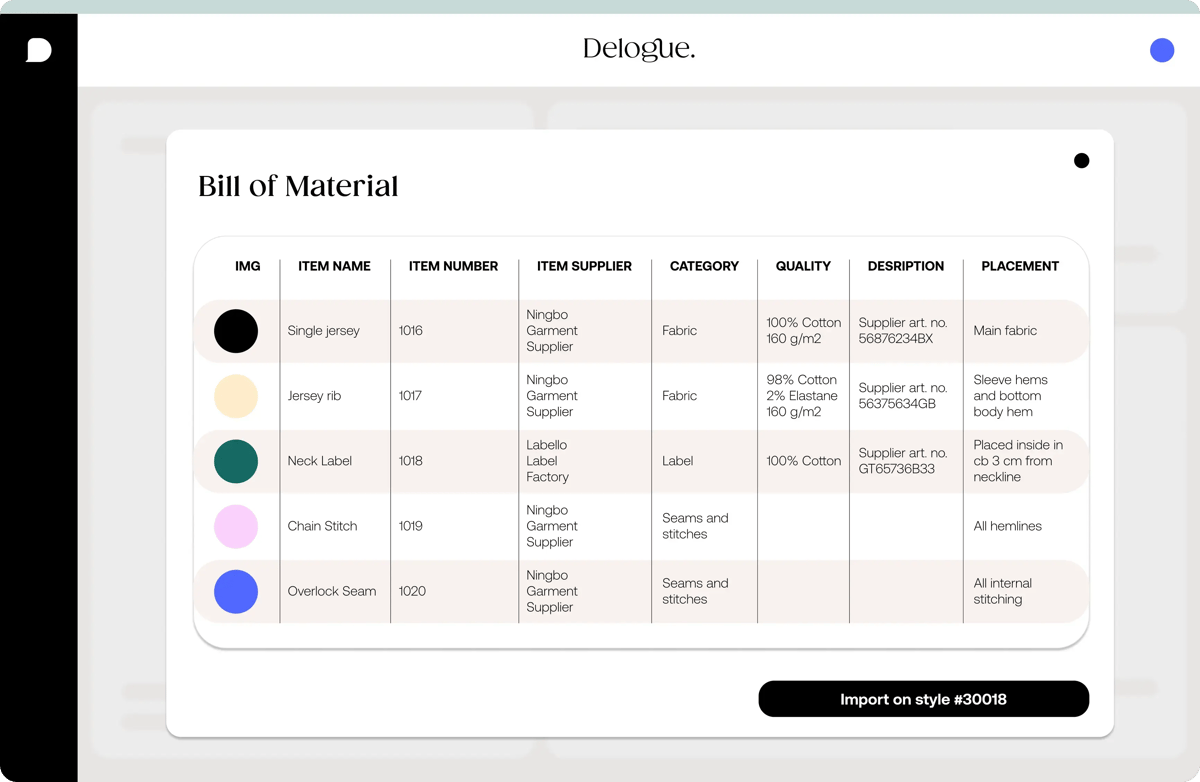
When we talk about supply chain mapping, many might not immediately think of a PLM as the place for it. But when you take a closer look, it actually makes a lot of sense. Your garments already live there. Your components are there. Your Bills of Materials are there. In many ways, the foundation for mapping is already in place.
Instead of building mapping in separate tools or documents, it becomes much more natural to connect it directly to where products are developed. When mapping sits alongside styles, components, and suppliers, it turns into part of the workflow rather than an extra task. The information flows more easily, and decisions can be made with better context.
We have seen across the industry that many brands are asking the same questions. How do we do this? When do we start? And where should it live? That is exactly why we have started building this into Delogue. With the new supplier module, supply chain mapping becomes a natural extension of the product itself. Mapping styles and components directly in the system creates clarity, strengthens collaboration with suppliers, and makes compliance something that supports the process instead of slowing it down. Reach out to sales here to learn more about the supplier module.
“
“When brands and suppliers work from the same structure, mapping becomes a shared effort instead of a one-sided task.”
Eric Larratt, Senior Product Manager at Delogue PLM
Check out our monthly webinar
Every month, we host a webinar, often in collaboration with our IT solution partners and leading industry brands. The topics vary, but one thing remains the same: we aim to make the fashion industry’s challenges more manageable and share our take on practical, hands-on solutions.
Check out this month’s webinar by clicking the button below.
8 minute read