
.webp)
.webp)
.webp?width=600&height=349&name=menu%20item%20-%20fashion%20(1).webp)




.webp?width=2000&name=menu%20item%20-%20collaboration%20(2).webp)
.webp?width=2000&name=menu%20item%20-%20samples%20(1).webp)
.webp?width=2000&name=menu%20item%20-%20profit%20%26%20margins%20(1).webp)
.webp?width=2000&name=menu%20item%20-%20compliance%20(1).webp)





PLM & Product Development
5 minute read
From fabric composition to the smallest trim, every component influences how garment moves, lasts, and performs in real conditions. In this article, we explore why reliable materials are the foundation of technical product development and how brands can turn countless material decisions into a controlled and structured process.
From fiber to finished garment
So what do we actually mean when we talk about reliable materials? For many people the mind goes straight to fabric, and that makes sense. Fabric plays a huge role in how a garment performs. But in reality, it is only one part of a much bigger picture.
A garment is built from a whole combination of materials. The fabric itself, of course, but also treatments and coatings, seams, threads, buttons, zipper tapes, elastics, reinforcements and many other small components that quietly shape the final result. Each of these elements plays a role in how the product behaves once it leaves the development table.
This becomes especially clear in activewear and other technical garments. Here the customer is not only looking for something that looks good. They expect a product that performs. Something that can handle long runs, intense movement, changing weather and repeated washing without losing its purpose.
“
“Performance is never created by one material alone. It’s the combination of fabrics, trims, and construction that makes the garment truly work”
Casper Munch-Andersen, Onboarding Specialist at Delogue
Fabric first: the engine of performance
Let’s look a little closer at the many decisions made during product development. While every material choice matters, there is one element that truly drives the garment, and that is the fabric. Fabric shapes how the product performs, feels, and moves, and in activewear it often becomes the starting point for the entire design.
You would rarely use the same fabrics across different sports, let alone the same ones used in everyday fashion. Each activity has its own demands. Some require high stretch and moisture management, others focus on insulation, abrasion resistance, or breathability. The needs shift depending on how the garment will actually be used.
What is fascinating is how small adjustments can make a big difference. A slight change in fiber composition, a different fabric weight, or a new construction can completely alter how the garment performs. The possibilities are wide, which means these decisions come up again and again during development. That is why fabric choices need to be intentional and clearly documented from the beginning. Changing fabrics later in the process can affect fit, testing results, compliance requirements, and the overall performance of the garment. Getting it right early helps the entire product come together with much greater confidence.
When trims become technical decisions
Let’s shift the focus a little from fabrics to all the other components that bring a garment to life. Zippers, elastics, drawcords, tapes, threads, reinforcements, and labels may seem like small details, but in technical apparel they play a surprisingly big role in how the product performs.
Take cycling bibs as an example. If you are not familiar with them, they are cycling shorts held up by shoulder straps instead of a waistband. They might look unusual at first, but every detail is there for a reason. The bib straps remove pressure around the waist and keep the shorts securely in place. Mesh panels in the straps help with ventilation. Silicone grippers at the leg openings stop the shorts from sliding up during long rides. A chamois pad provides comfort in the saddle, while flatlock seams reduce irritation against the skin.
When a cyclist spends hours in the saddle, often riding well over 100 kilometres, these details matter. Each component contributes to how the garment feels and performs in motion. Even small adjustments can change the experience completely. In technical garments, trims are not decorative extras. They are part of the engineering that makes the product work.
Turning materials into a controlled system
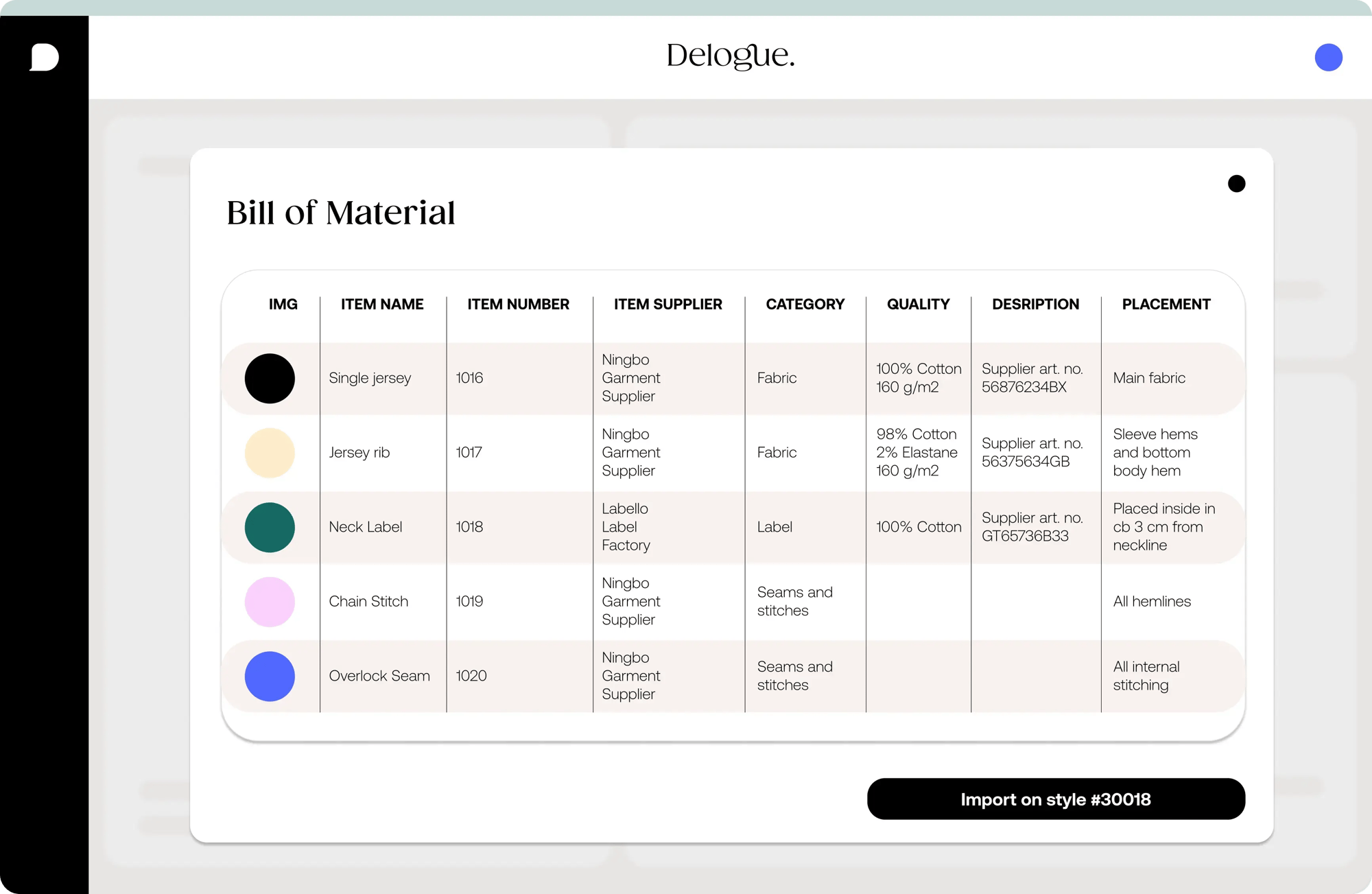
With so many decisions around fabrics, trims, and components, all of this information needs a place to live. Even a single garment can easily contain ten or more materials, and without structure it quickly becomes difficult to keep track. What fabric weight did we finally choose? Which zipper version was approved? Which trim passed testing and which one did we move away from? When details are scattered across files and emails, clarity disappears fast. This is where structure makes the work much easier. When fabrics and trims are stored in a shared component library with their specifications, certifications, and documentation attached, teams no longer have to rediscover the same information every season. Materials that have already been tested and approved can be reused with confidence.
“
“Delogue helps us bring all product info, materials, and suppliers together in one place, so we can make informed decisions.”
Kirsten Tolman, Product and Development Manager at Brands of Q
A PLM helps bring that structure to life. It creates one place where materials can be stored once, documented properly, and then reused across collections. Components can be added directly into Bills of Materials and shared clearly with suppliers. Instead of starting from scratch every time, teams gain an overview of what they already have, how materials perform, and how everything connects across products. That kind of control makes development calmer, faster, and far more reliable.
Check out our monthly webinar
Every month, we host a webinar, often in collaboration with our IT solution partners and leading industry brands. The topics vary, but one thing remains the same: we aim to make the fashion industry’s challenges more manageable and share our take on practical, hands-on solutions.
Check out this month’s webinar by clicking the button below.
5 minute read